

How to Start Halloween Kindness Traditions That Stick
Learn how to start Halloween kindness traditions your kids will love. Simple steps, a 31-day kindness calendar, and candy-free ideas for families.
Table of Contents
- Why Halloween Kindness Traditions Beat More Candy
- Step 1: Pick One Small Halloween Kindness Activity to Anchor October
- Step 2: Build a Halloween Kindness Calendar for the Whole Month
- Step 3: Choose Alternatives to Halloween Candy for Kids
- Step 4: Make It a Halloween Tradition to Start With Family
- Step 5: Keep the Kindness Going Beyond Family and Neighbors
- Step 6: Track Participation So the Tradition Survives November
- Common Mistakes That Sink a New Kindness Tradition
- Frequently Asked Questions
Last Updated: October 19, 2026
Why Halloween Kindness Traditions Beat More Candy
Most families end October with a mountain of candy and little memory of what happened. At Boo Buddy Magic, we built our company around one idea: kids remember the good they do far longer than the sweets they eat.

Most guides treat kindness as one more October to-do item next to costumes and pumpkins. A tradition only works when it's small, repeatable, and fun enough that your kids ask for it.
So how do you start Halloween kindness traditions without adding stress to a busy month?
Parents tell us the shift from "what do I get?" to "what can I give?" changes the holiday's whole mood: warm instead of rushed.
Step 1: Pick One Small Halloween Kindness Activity to Anchor October
Start with a single activity, not a list. One clear action repeated all month beats five scattered good deeds.
A good anchor activity has three traits:
- It takes under 10 minutes
- It needs no shopping trip or prep
- A 3-year-old can do it with a little help
Kindness Ideas That Fit Ages 3 to 8
Match the activity to your child's age, then let them grow into harder ones next year.
- Ages 3 to 5: Draw a picture for a neighbor, hand out stickers, or say one nice thing at dinner.
- Ages 5 to 7: Help bake a treat for a friend, pick up litter on a walk, or call a grandparent just to chat.
- Ages 7 to 8: Write a thank-you note to a teacher, donate a toy, or rake a neighbor's leaves.
Step 2: Build a Halloween Kindness Calendar for the Whole Month
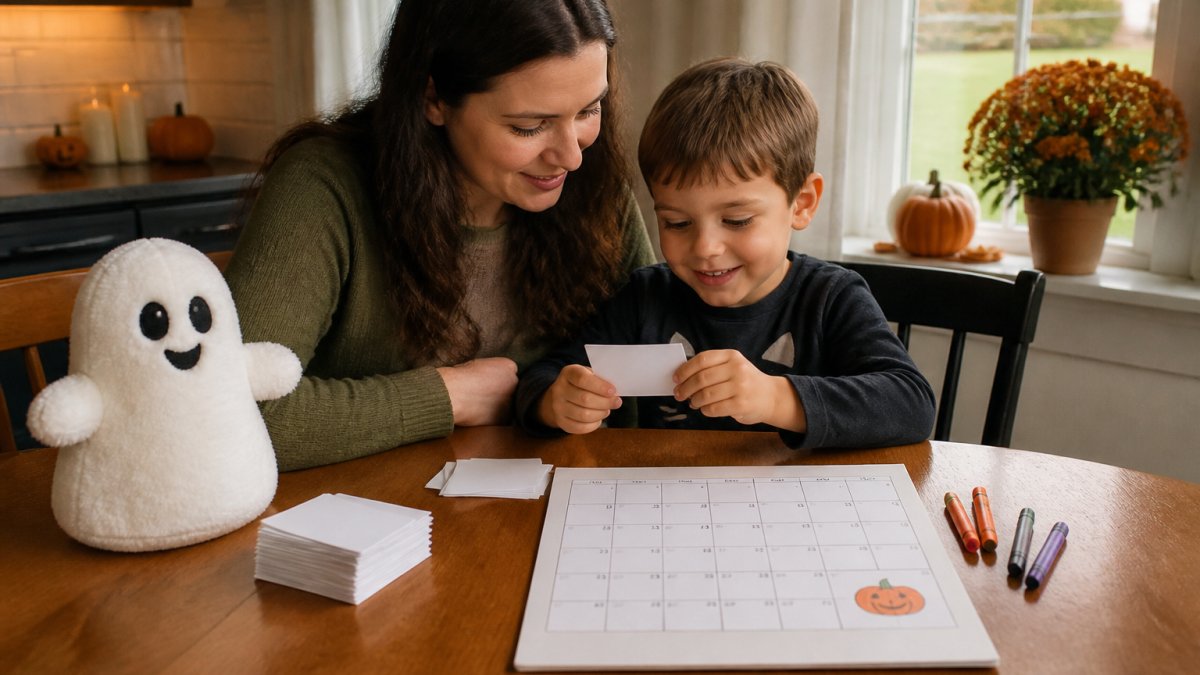
A Halloween kindness calendar turns good intentions into a daily habit. Map one small act to each day of October and post it where everyone sees it, so the calendar does the remembering.
A paper calendar on the fridge works. Write one prompt per day, or use pre-written cards to skip the planning.
A Prompt Bank You Can Copy
Most families stall staring at 31 blank squares. Start from a prompt bank grouped by effort level, then assign prompts to days that fit your schedule:
- Under 5 minutes (use on school nights): Say one thing you're thankful for at dinner; draw a chalk heart on the sidewalk; wave to a neighbor; put a sticker on a sibling's lunch bag; tell a family member one thing they did well today.
- 5 to 15 minutes (use on lighter evenings): Write a two-line thank-you note to a teacher; sort outgrown toys for donation; make a card for a grandparent; pick up litter on your block with gloves; bake and deliver one plate to a neighbor.
- Weekend or longer (use on Saturdays and Sundays): Deliver cards to a local nursing home; collect food for a community pantry; make thank-you notes for mail carriers and delivery drivers; rake a neighbor's leaves; assemble a care package for a family member far away.
Front-load bigger acts onto weekends and keep weeknights to the under-5-minute list. That one rule prevents the mid-month collapse that sinks most new traditions.
Build It in About 15 Minutes
- Print or draw a 31-square calendar and post it at kid height.
- Mark busy nights first, then fill those with under-5-minute prompts.
- Slot 5-to-15-minute acts into normal evenings and weekend acts onto Saturdays and Sundays.
- Write each prompt in your child's words, not yours.
- Let your child cross off each day and pick the next day's card the night before.
Keep prompts short: "Tell someone why you're thankful for them" beats a vague "be kind today."
Make It Inclusive From the Start
A calendar that only works for one kind of kid won't become a tradition. Build in options for different ages, abilities, and comfort levels:
- Shy or sensory-sensitive kids: Offer a draw-or-write choice, and let them leave a note instead of speaking to a neighbor.
- Kids with limited mobility: Swap litter pickup for card-making or a phone call to a relative.
- Non-trick-or-treating families: Treat the calendar as the main October ritual, with a home movie night or a decoration walk as the celebration.
Step 3: Choose Alternatives to Halloween Candy for Kids
Candy-free giving solves a real problem: many kids have food allergies, and some families don't want more sugar. Swapping candy for small non-food treats makes your porch a safe stop for every kid.
Good alternatives to Halloween candy for kids include:
- Glow bracelets and glow sticks
- Stickers and temporary tattoos
- Small toys like bouncy balls or tops
Allergy-Aware and Consent-Friendly Giving
Safety comes first when you hand things out. The Teal Pumpkin Project from Food Allergy Research & Education encourages households to offer non-food treats so kids with food allergies can trick-or-treat safely.
Consent matters too. Ask before handing a child anything, and let them choose. Never pressure a shy kid to take a treat or pose for a photo. Respect a "no thank you" the first time.
Never hand out homemade treats to trick-or-treaters you don't know. Food allergies and safety concerns mean sealed, store-bought items or non-food treats are the safer choice for porch giving.
Step 4: Make It a Halloween Tradition to Start With Family
Charity starts at the kitchen table. Before asking kids to be kind to strangers, practice kindness at home, where young children have a safe place to build the habit.
Try these simple family kindness rituals:
- A nightly "kindness rose and thorn" at dinner
- A sibling helper jar with one small task per slip
- A family gratitude pumpkin you add to each day
The goal is repetition, not perfection. A 4-year-old sharing a toy with a sibling practices the exact skill they'll use with neighbors later.
This is where a physical object helps. A plush friend like the Boo Buddy Arrival Box gives kids something to hold while they do each day's kind act.
Step 5: Keep the Kindness Going Beyond Family and Neighbors
Kindness doesn't stop at your street. Once your child is comfortable with small acts at home, widen the circle, and the Halloween tradition starts to feel like part of your family's identity.
Ideas that reach further:
- Deliver cards to a local nursing home
- Collect food for a community pantry
- Make thank-you notes for mail carriers and delivery drivers
The Corporation for National and Community Service notes that family volunteering builds strong habits early. Kids who serve alongside parents are more likely to keep serving as adults.
Step 6: Track Participation So the Tradition Survives November
A tradition dies when everyone forgets it by November 1. Tracking keeps it alive, but only if it measures something your child can see and feel.
Ways to track your Halloween kindness activities for kids:
- A sticker chart on the fridge
- A jar of "kindness sparks" (pom-poms or beads)
- A photo album of each act
The Boo Buddy Ultimate Glow Bundle makes tracking built-in. Each of the 31 daily kindness cards gives your child one prompt per day, and the glowing heart collects the "sparks" they earn. When the month ends, you have a record of everything they did.

Measure Participation Without Turning It Into a Chore
Families quit trackers because the tracker asks too much. Keep it to three numbers you can count in under a minute at bedtime:
- Days completed: How many squares got crossed off this week.
- People reached: How many different people received a kind act (a neighbor, a teacher, a grandparent).
- Acts your child initiated: How many times your child started the act without a reminder.
Write those three numbers on a sticky note each Sunday. That's the whole system, and it tells you whether the tradition is becoming a habit (initiated acts rising) or a parent-led assignment (initiated acts flat).
Handle Missed Days and Fading Interest
A missed day is not a failure; it is data. Interest commonly dips around the third week, right when novelty wears off and candy pressure peaks. Plan for it:
- Missed days: Move the prompt to the next open square. Never double up to "catch up."
- Fading interest: Let your child pick the next three prompts from the bank. Choice restores buy-in faster than encouragement.
- Sibling rivalry: Track sparks per child, not as a family total, so one child's pace doesn't become another's scoreboard.
Run a Wrap-Up Ritual That Sets Up Next Year
The closing moment is what makes kids ask to do it again. Set aside 20 minutes on October 31 or November 1 for a short ceremony:
- Have your child count their kindness sparks or crossed-off squares.
- Ask them to name one favorite act and one person they want to help again.
- Write those two answers on the back of next year's calendar and store it with the decorations.
- Celebrate with something small and repeatable, like a special dinner or a glow-in-the-dark walk around the block.
That stored note is the real tracker. Next October you start from a record of what worked instead of a blank page.
Common Mistakes That Sink a New Kindness Tradition
Most new traditions fail for the same few reasons. Avoid these and yours has a real shot at lasting.
| Mistake | Fix | Why It Matters |
|---|---|---|
| Starting too big | Pick one small act | Big plans collapse by week two |
| No visible reminder | Post a calendar | Kids forget without a cue |
| Forcing participation | Offer choices | Pressure kills the fun |
| Skipping the reward | Celebrate with a glow or sticker | Kids need to see progress |
| Stopping on November 1 | Plan a wrap-up ritual | Closure makes them want more |
The biggest mistake is treating kindness as a lecture. Keep it playful and your kids will lead the way.
Starting a kindness tradition takes one small step and a little repetition. Boo Buddy Magic makes that step easier with a glow-in-the-dark plush, 31 daily kindness cards, and a storybook that introduces the whole idea on day one. Our First Edition is limited to 4,500 units, so families who want a keepsake companion for October can shop the Boo Buddy collection today.
Frequently Asked Questions
How can I start a Halloween kindness tradition with my kids?
Pick one small action and repeat it daily through October. A simple setup works best: choose a kindness prompt each morning, do it together, then talk about it at bedtime. A Halloween kindness calendar takes the planning out of it, so you are not inventing a new idea every night. Start with three days a week if daily feels like too much, and add more once the routine sticks.
What are easy Halloween kindness activities for kids ages 3 to 8?
Younger kids do best with visible, hands-on acts: drawing a card for a neighbor, handing a glow bracelet to a friend, or helping sort donations. Older kids in that range can take on slightly bigger jobs, like choosing candy-free treats for trick-or-treaters or delivering homemade decorations to a grandparent. Keep each activity under 15 minutes and let your child pick from two options so they feel ownership.
How do I make a Halloween kindness tradition simple and low-stress?
Remove the daily decision. Pre-written kindness cards, a printed calendar, and one designated spot for supplies mean you never have to plan on the fly. Set a fixed time, such as after dinner, so it becomes part of the routine rather than one more item on your list. If a day gets missed, skip it without guilt and pick up the next day.
What are good alternatives to Halloween candy for kids?
Glow bracelets, stickers, temporary tattoos, small coloring books, and pencils all work as trick-or-treat handouts and cost little per piece. Non-food items also solve the allergy problem, since roughly 1 in 13 children has a food allergy, according to Food Allergy Research & Education. Keep a separate teal pumpkin bucket for non-food treats so families with allergies can spot it easily.
Prev post

Low-Stress Halloween Traditions for Families
Updated on 21 October 2026
Next post

Simple Acts of Kindness for Kids: 31 Ideas to Build Empathy
Updated on 18 October 2026


